
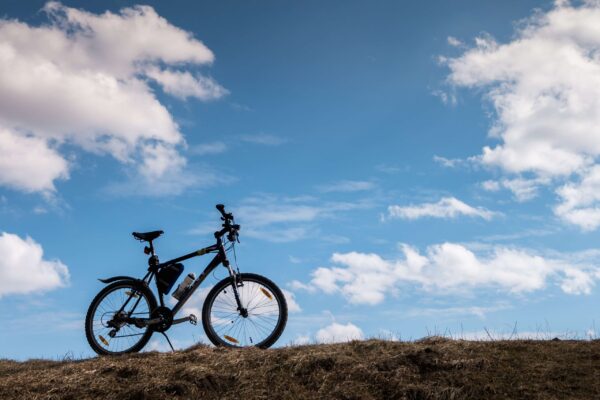
Mountain biking is an exciting activity chosen by people of different ages. Despite initial fears associated with completely new and quite unfamiliar equipment, high-speed riding over rough terrain will certainly bring special pleasure and provide unforgettable emotions. But to begin with, novices should “immerse themselves” in the world of mountain biking. In this overview, you can learn how not to make mistakes when choosing your first mountain bike, what equipment may be needed, and which routes are best to consider.
Understanding the Concept: What Is a Mountain Bike?
A mountain bike is called an excellent way to explore trails and paths located far from cities (from paved surfaces and cars). Such transport has no strict restrictions regarding age category or initial level of preparation. This bicycle has a well-thought-out design that is initially calculated for operation in off-road conditions. For this purpose, the bicycle has been supplemented with wide treaded tyres that provide excellent grip on difficult road surfaces.
Additionally, there is a quality suspension for absorbing all irregularities, as well as a strong frame that copes with all loads intended for it. The geometry of a mountain bike ensures that the cyclist occupies a comfortable position, allowing them to fully control the entire road. For easy overcoming of obstacles, there is a flat handlebar and a wide range of gear ratios to choose from. This is important for safe descents and ascents.
Main Types of Mountain Bikes: Which Should a Beginner Choose?
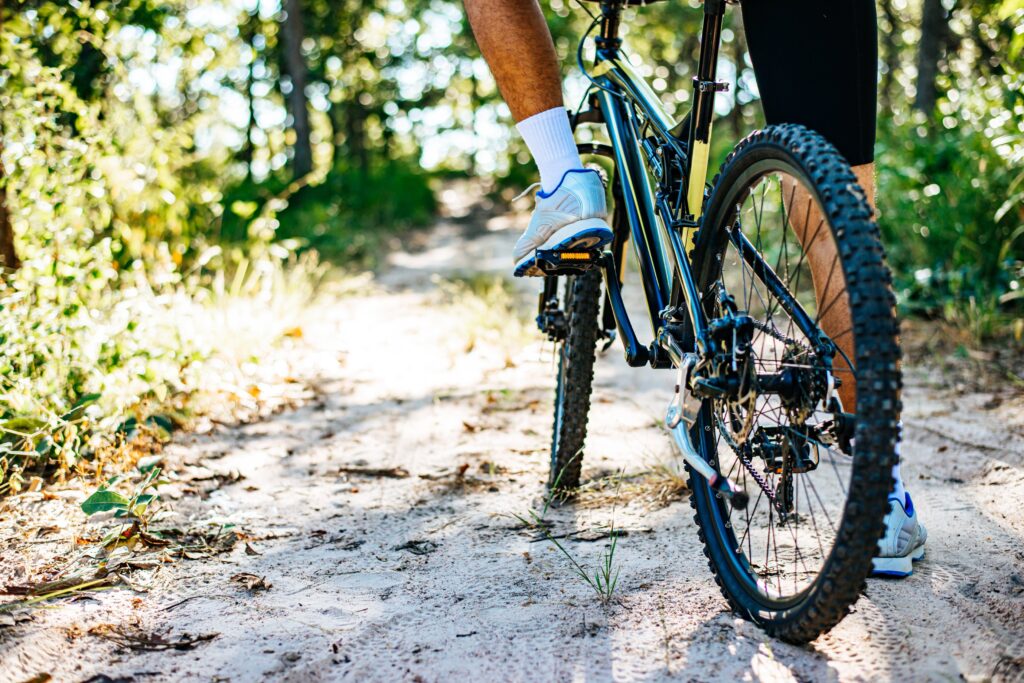
All modern mountain bikes can be divided into two large categories:
- Hardtails – a type of mountain bike with a suspension fork located at the front. The difference from other bicycles is the presence of a rigid frame. Depending on the magnitude of the suspension, several subtypes are distinguished. Taking into account specific geometry, it is possible to select the ideal option for one’s own riding style.
- Full suspension – these are bicycles with full suspension that have received a suspension fork and a suspended rear section. Such transport guarantees maximum comfort during riding: the presence of additional elasticity eliminates the probability of stress on joints, which reduces the overall load on the entire body (especially important when riding over rocky or root-covered terrain).
Compared to a hardtail, a full suspension bicycle is distinguished by improved handling and increased speed even in conditions of uneven terrain. However, due to the additional suspension, they are quite heavy and more difficult to maintain. Therefore, the choice of a specific type depends on the individual preferences of the future cyclist.
Various Subtypes of Mountain Bikes for Different Riding Styles
Based on certain riding styles, many different subtypes are available for sale. Each of these subtypes has special differences and characteristics.
The most common subtypes:
- XC (cross-country) mountain bikes – lightweight models whose suspension travel ranges from 100-120 mm. This is an excellent option for racing in rough terrain conditions.
- Trail bikes – the suspension travel in these models ranges from 130 to 150 mm. They are designed for comfortable climbing uphill and comfortable descent.
- Enduro bikes – their suspension travel is 150-190 mm. Due to their strength and reliability, such bicycles cope excellently with steep descents and diverse terrain reliefs.
- Downhill bikes – have a large suspension travel (around 200 mm). They were created for descending the steepest and most uneven slopes.
- Electric bikes – a relatively new but confidently developing sector. They are divided into two categories: lightweight models with smaller batteries and full-fledged electric bikes with increased range.
The choice of the ideal bicycle depends on the future riding style, as well as the allocated budget for purchasing two-wheeled transport.
Useful Equipment and Comfortable Clothing
For mountain biking, a set of special clothing and corresponding accessories is offered. First of all, it is necessary to purchase protective equipment and accessories: a helmet of suitable shape and size; a pair of gloves; protective knee pads and elbow pads. Additionally, one should choose a water bottle that will be fixed to the frame.
For comfortable riding, additional items of clothing and footwear are also essential. For example, clipless shoes with cleats for fixing to pedals will be required. As a result, improved control of the bicycle occurs even in conditions of uneven surfaces. For a long bike ride, padded shorts may be needed.
To have the ability to perform minor repairs and quick maintenance of the bicycle on the road, one cannot do without a compact pump, a spare tube, and a puncture repair kit.
Where Can You Ride Mountain Bikes?
For riding, beginners can choose special trail tourism centres with equipped trails or natural paths with “wild” trails. The first option is more preferable for beginners for the reason that trails for different levels of preparation will be offered to choose from. As for natural paths, before the start of the trip, one should carefully study all the features of the specific mountainous terrain, read reviews from other riders, and it is best to take an experienced cyclist along as a companion.
Setting Up a Mountain Bike and Preparing for the First Ride
Before starting to ride, attention should be paid to several basic recommendations that will help a novice feel more confident on the trail.
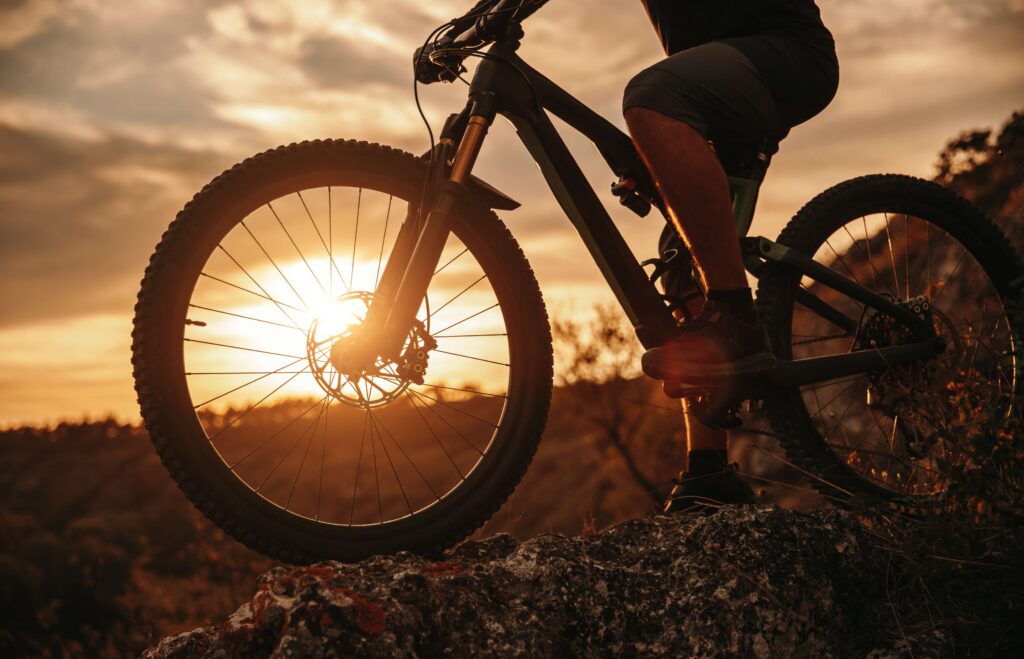
Main recommendations:
- One needs to stand next to the mountain bike and adjust the seat height – the saddle should be at hip level.
- Brake levers are adjusted in a wide range – from a horizontal position to a position at a 45-degree angle to the ground. Everything depends on the cyclist’s posture.
- One needs to check the tyre pressure, on which comfort during riding and grip with the road surface depend.
- For beginners, it is recommended to use clipless pedals so that feet do not slip during the ride.
An equally important point is also the adjustment of the suspension. Adjustment is carried out taking into account the individual riding style and weight of each cyclist.